Plasma Polymer Films

A high degree of crosslinking of solid plasma polymers and the resulting random network constitute the main reason why these materials are regarded as amorphous. The application of Sir Mott's [2] theory of electronic structure of amorphous solids to plasma polymerized thin films is, therefore, an entirely justified approach.
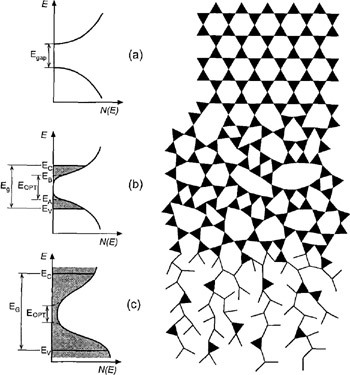
To understand the nature of the electronic structure of the amorphous state it is simplest to start from the electronic structure of a crystalline material. It is widely recognized that such a structure is described by the band model based on the periodicity of the crystal lattice. Schematically, a two-dimensional crystal model and a corresponding band model (energy distribution of density-of-states) are shown in Fig. 5.2(a). The black triangles represent a short-range order. A periodic array of the triangles gives the crystal lattice (a long-range order). In this case the band model, in its simplest version, is the following: two bands of extended states exist the conduction and valence bands and they are separated by the forbidden band (bandgap) E gap. Electrons and holes can be transported through the crystal if their energies are in a range of the conduction or valence bands, respectively.
If we provoke a disorder of the periodicity simultaneously maintaining the short-range order, we transform the crystal structure to the amorphous state. We may...