The Stress-Strength Model And Its Generalizations: Theory and Applications

Chapter 2: The Theory and Some Useful Approaches

2.1 The Maximum Likelihood Estimators

2.1.1 The Theory

The maximum likelihood estimation (MLE) is undoubtedly the most popular (at least until now) procedure for estimation of reliability R=P(X due to its flexibility and generality. The technique can always be used if the joint distribution of the stress X and the strength Y is a known function with some unknown parameters. A detailed description of the MLE method is presented, for example, in Casella and Berger (1990) and Lehmann and Casella (1998). Here, we shall concentrate on a discussion of the MLE of the reliability R=P(X

Assume that a random vector (X,Y) has the probability density function (pdf) f(x, y ?) with an unknown scalar or vector-valued parameter ? ? ?. The aim is to estimate R on the basis of observations ( X 1, Y 1), ,( X n, Y n) Note that if X and Y are independent with the pdf of the form

(2.1)

the number of observations for X and Y need not be the same. In general, the data is of the form ( X , Y )

(2.2)

with n 1 =n 2 if X and Y are dependent.

Let f( X , Y ; ?) denote the joint pdf of the data, i.e.

(2.3)

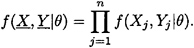
Note that if X and Y are independent, (2.3) becomes

(2.4)

Definition 2.1

Given that ( X

UNLIMITED FREE
ACCESS
TO THE WORLD'S BEST IDEAS

SUBMIT
Already a GlobalSpec user? Log in.

This is embarrasing...

An error occurred while processing the form. Please try again in a few minutes.

Customize Your GlobalSpec Experience

Category: Automated Test Equipment
Finish!
Privacy Policy

This is embarrasing...

An error occurred while processing the form. Please try again in a few minutes.