3.7.1 Multivariate Discrete Distributions
Let us consider, similarly to Sections 3.4, two independent k 1 and k 2 -component random vectors  and
and  . Again, as in Section 3.4, our goal will be to estimate the probability R= P( A ? X+ B ? Y+ C>0) on the basis of i.i.d. samples (3.101). Here, as before, A and B are known k 1 and k 2-dimensional vectors and C is a known scalar.
Multivariate Poisson distribution. The probability that a k-variate vector X with the multivariate Poisson (k, ?) distribution takes the value x is given by
| (3.183) | 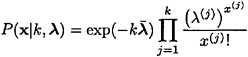
|
where ?=( ? (1), , ? (k)) is a vector with positive components, 
 and x=( x (1), , x (k)) is a k-variate vector with nonnegative integer components.
Let independent vectors X and Y have multivariate Poisson distributions Poisson( k 1, ? 1) and Poisson( k 2, ? 2), respectively. Define X and Y by (3.104), and note that X and Y are the MLEs of the vector parameters ? 1 and ? 2, respectively. Then, from general theory (see Section 2.1.4) it follows that the MLE of R is
| (3.184) | 
|
where x and y take all possible nonnegative integer values. The series in (3.184) converges quite rapidly, and thus, one can use...

 TABLE OF CONTENTS