Theory And Applications Of Ocean Surface Waves
Presenting theoretical topics on ocean wave dynamics, this text includes basic principles and applications in coastal and offshore engineering as well as coastal oceanography.
 TABLE OF CONTENTS
 As pointed out in Chapter One, the linearized shallow-water approximation is useful only if the following two length ratios are small:
| (12.1.1) | 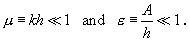 |
The second restriction is a severe one for many coastal problems; therefore, a nonlinear theory of shallow water waves is needed. The presence of two small parameters (three length scales) introduces new subtleties into the procedure of approximation since the magnitude of one ratio relative to the other is now important. Historically, two different theories, one by Airy and the other by Boussinesq (1877), and Korteweg and de Vries (1895), were separately developed which led to opposite conclusions regarding wave breaking on constant depth. The confusion was resolved in a fundamental paper by Ursell (1953) and further clarified by Lin and Clark (1959). In particular, Ursell has shown that the ratio
| (12.1.2) | 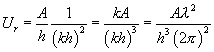 |
plays a central role in deciding the choice of approximations which correspond to very different physics. This ratio has since been widely referred to as the Ursell parameter and will be denoted by U r in this book, although it also appeared in the earlier theory of Stokes.
For simplicity we shall illustrate the approximation procedure for constant depth, using the formalism of Benney (1966) and Peregrine (1967). The extension to variable depth is left as an exercise.
Since there are now two small parameters, it is advantageous to use dimensionless variables for the sake of clarity. The scales of the variables are suggested by the linearized theory: