Overview
Since the spectrum of the correlation function has the form, Q( k) = c/ k 2 where c is a constant [Field, 1987], Q( r) satisfies
This can be easily shown by taking Fourier transformation of both sides of this equation. In principle, a gauge g( r) which satisfies ? 2 g( r) = 0, can be added to Q( r). But the only such gauge, which is radially symmetric, is a constant (denoted as b).
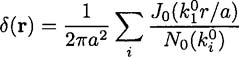
A representation for the radially symmetric form of the ?( r) function in terms of Bessel functions, is
where J t is the lth order Bessel function, k i 0 is the ith zero of J 0, r and ? are the polar coordinates of r, and N 0( k j 0) = ? 1 0 rdr[ J 0( k j 0 r)] 2 is the normalization constant of J 0( k j 0 r). Therefore it can be seen that
since it solves Equation 5A.1. Using an addition theorem for Bessel functions, we obtain a representation for the correlation function Q( r ? r ?)
We shall rewrite this correlation function in terms of the normalized Bessel-Fourier basis W mi. These functions are zero on the boundary and take the form [Jackson, 1975]
In which N m


 TABLE OF CONTENTS