A correlation function is by definition positive semi-definite. This implies that every projection of the correlation function is positive. Mathematically any vector v with the same dimensionality as the correlation function Q has the property that
Therefore all eigenvectors have positive eigenvalues. It follows that not every function is a correlation function and some of the functions used by different researchers are indeed not correlation functions. In some of these cases, for instance in the papers by Linsker, this comes about since he creates a pseudo-correlation function Q ? = Q ? k 2 J which may have some negative projections.
As part of our software package, we can create environments from a specified correlation function. These environments have Gaussian statistics with a pre-specified covariance matrix. However this can be done only if the specified function is positive definite. Since simulations of second order learning rules are affected only by several eigenvectors those with the highest eigenvalues this problem can be overcome by creating instead an equivalent positive definite correlation function.
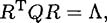
How is this done? Assuming a matrix Q is specified, that is symmetric and real. Such a matrix can be diagonalized by a rotation matrix R such that
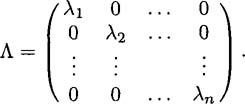
where ? is a diagonal matrix composed of the eigenvalues of Q:
We assume that eigenvalues are arranged in descending order, ? 1 > ? 2 > > ? n. The rotation matrix R is composed...
Copyright World Scientific Publishing Co. Pte. Ltd. 2004 under license agreement with Books24x7


 TABLE OF CONTENTS