Theory Of Cortical Plasticity

Chapter 7: Ocular Dominance in Normal and Deprived Cortex

Overview

The shift in ocular dominance in monocular deprivation is probably the most robust result of deprivation during the critical period. This experience dependent plasticity of binocular vision during the critical period is an important reason for choosing the visual system as a model system for theories of synaptic plasticity.

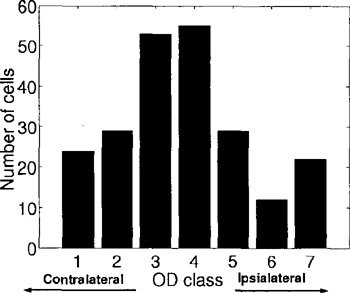
Most cortical cells in kittens are binocular, this means that they respond to stimuli from either eye [Hubel and Wiesel, 1962]. There are a few cells which are monocular (respond to only one eye), but they are far fewer in number. The amount by which a cell responds to one eye or another is called ocular dominance. Traditionally these cells have been categorized into 5 or 7 categories[Hubel and Wiesel, 1965]. In a normal cortex this results in ocular dominance distributions as seen in Figure 7.1.


Figure 7.1: The normal distribution of ocular dominance in kitten visual as measured by Hubel and Wiesel, 1965. The cortex displays a range of cells dominated by responses to the left and right eyes, with many cells responding equally to both.

Although most cortical cells are binocular, the majority of such cells are dominated by inputs from one of the eyes. Cells with similar ocular dominance are usually clustered together in the cortex, in elongated bands, that are referred to as ocular dominance columns.

There has been a long ongoing dispute as to how much the development of the ocular dominance distributions and ocular dominance columns is activity or experience dependent[Crowley...

UNLIMITED FREE
ACCESS
TO THE WORLD'S BEST IDEAS

SUBMIT
Already a GlobalSpec user? Log in.

This is embarrasing...

An error occurred while processing the form. Please try again in a few minutes.

Customize Your GlobalSpec Experience

Category: Biological Microscopes
Finish!
Privacy Policy

This is embarrasing...

An error occurred while processing the form. Please try again in a few minutes.