3G Wireless Networks
Featuring many examples showing network architectures, internetworking, protocol use, and integration, this book supplies the answers you need for key networking decisions.
 TABLE OF CONTENTS
 The rapid increase in the demand for data services, primarily IP, has been thrust upon the wireless industry. Over the years there has been much anticipation of the onslaught of data services, but the radio access platforms have been the inhibitor from making this a reality. Third generation (3G) is a term that has received and continues to receive much attention as the enabler for high-speed data for the wireless mobility market. 3G and all it is meant to be are defined in the ITU specification International Mobile Telecommunications-2000 (IMT-2000). IMT-2000 is a radio and network access specification defining several methods or technology platforms that meet the overall goals of the specification. The IMT-2000 specification is meant to be a unifying specification, enabling mobile and some fixed high-speed data services to use one or several radio channels with fixed network platforms for delivering the services envisioned:
Global standard
Compatibility of service within IMT-2000 and other fixed networks
High quality
Worldwide common frequency band
Small terminals for worldwide use
Worldwide roaming capability
Multimedia application services and terminals
Improved spectrum efficiency
Flexibility for evolution to the next generation of wireless systems
High-speed packet data rates
2 Mbps for fixed environment
384 Mbps for pedestrian
144 Kbps for vehicular traffic
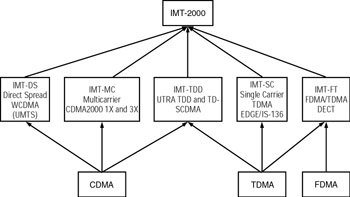
Figure 4-1 shows the linkage between the various platforms that comprise the IMT-2000 specification group.
The definition of what exactly 3G encompasses is usually clouded in marketing terms, with the technical reader desiring a straightforward...