3G Wireless Networks
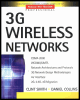
Featuring many examples showing network architectures, internetworking, protocol use, and integration, this book supplies the answers you need for key networking decisions.
 TABLE OF CONTENTS
 Universal Mobile Telecommunications Service (UMTS) represents an evolution of Global System for Mobile communications (GSM) to support third-generation (3G) capabilities. In this chapter, we examine the details of the UMTS, including the air interface and network architecture. The initial focus is on the air interface and radio access network (RAN), as these represent the greatest change from the technologies of GSM, the General Packet Radio Service (GPRS), and the Enhanced Data Rates for Global Evolution (EDGE). Subsequently, we delve into the specifics of the core network and examine the planned evolution of the UMTS over the next few years. First, however, some general information on UMTS technology.
As described briefly in Chapter 4, "Third Generation (3G) Overview," UMTS includes two of the air interface proposals submitted to the International Telecommunications Union (ITU) as proposed solutions to meet the requirements laid down for International Mobile Telephony 2000 (IMT-2000). These both use Direct Sequence Wideband CDMA (DS-WCDMA). One solution uses Frequency Division Duplex (FDD) and the other uses Time Division Duplex (TDD). The FDD solution is likely to see the greatest deployment particularly in Europe and the Americas. The TDD solution is likely to see deployment primarily in Asia. In this chapter, we focus mainly on the FDD option.
In the FDD option, paired 5-MHz carriers are used in the uplink and downlink as follows: uplink 1920 MHz to 1980 MHz; downlink 2110...