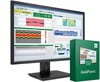
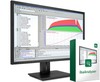
Adapted Wavelet Analysis from Theory to Software

Containing an overview of mathematical prerequisites, this detail-oriented book describes hands-on techniques for implementing special programs for signal analysis and other applications.
 TABLE OF CONTENTS
 Our goal is to convert some of the algorithms of mathematical analysis into computer programs. This requires as much thought and subtlety as devising the algorithms themselves. It is also fraught with hazards, since there is no acceptable procedure for proving that a computer implementation of a nontrivial algorithm is correct. Even if the underlying algorithm is supported by mathematical proof, the peculiarities of computation in practice might still lead to unexpected results. Thus the first part of this chapter is devoted to listing some of the most common problems encountered while transferring mathematical analysis into software.
The second part is devoted to listing some of the data structures used in the analyses which follow. Others will be introduced as the need arises. The purpose is to make the reader familiar with our scheme for presenting algorithms, as well as to review some of the common manipulation techniques used with trees, arrays, and so on.
Our algorithms are intended to be implemented on typical computing machines, which are subject to many practical constraints.
A computer can only represent real numbers to a finite degree of precision. For reasons of efficiency, this precision is normally fixed for all quantities used during the calculation. Thus for each computer there is a small number ? f > 0 such that for all 0 ? ? ? ? f, we have 1.0 + ? = 1.0 but 1.0 + ?' ?