Adapted Wavelet Analysis from Theory to Software

Containing an overview of mathematical prerequisites, this detail-oriented book describes hands-on techniques for implementing special programs for signal analysis and other applications.
 TABLE OF CONTENTS
 A convolution-decimation operator has at least three incarnations, depending upon the domain of the functions upon which it is defined. We have three different formulas for functions of one real variable, for doubly infinite sequences, and for 2 q-periodic sequences. We will use the term quadrature filter or QF to refer to all three, since the domain will usually be obvious from the context.
Here u = u( n) for n ? Z, the aperiodic case, or n ? Z/ q Z = {0, 1, ..., q - 1}, the periodic case. Convolution in this case is a sum.
Suppose that f = { f( n) : n ? Z} is an absolutely summable sequence. We define a convolution-decimation operator F and its adjoint F* to be operators acting on doubly infinite sequences, given respectively by the following formulas:
| (5.1) |  |
| (5.2) | 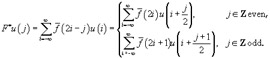 |
If f 2 q is a 2 q-periodic sequence ( i. e., with even period), then it can be used to define a periodic convolution-decimation F 2 q from 2 q-periodic to q-periodic sequences and its periodic adjoint  from q-periodic to 2 q-periodic sequences. These are, respectively, the operators
| (5.3) |  |
and
| (5.4) | 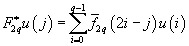 |
| (5.5) | 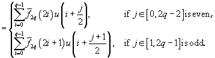 |
Periodization commutes with convolution-decimation: we get the same periodic sequence whether we first convolve and...