Adapted Wavelet Analysis from Theory to Software

Containing an overview of mathematical prerequisites, this detail-oriented book describes hands-on techniques for implementing special programs for signal analysis and other applications.
 TABLE OF CONTENTS
 Applying a convolution-decimation operator to a signal u is equivalent to multiplying the Fourier transform of u by a bounded periodic function. The bounded function is determined by the filter coefficients: This bounded function will be called the filter multiplier corresponding to a filter sequence f, and is defined by the following formula:
| (5.55) | 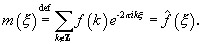 |
This function is also called the frequency response of the filter.
With a summable filter sequences, the filter multiplier is a uniformly convergent series of bounded continuous functions, hence is continuous by Proposition 1.1. If the filter sequence decreases rapidly at ?, then the frequency response function is smooth since the Fourier transform converts differentiation (of m) into multiplication (of f( k) by - 27 ?ik). A little bit of smoothness is very useful, so we will assume that there is some ? > 0 such that
| (5.56) | 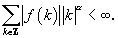 |
This will guarantee that m satisfies a H lder condition at every point, in particular at 0. Namely, we have:
If f satisfies Equation 5.56 for some 0 < ? < 1, then for all ? we have m( ?) - m(0) < C ? ?.
Proof: We will show that m( ?) - m(0) ? - ? is a bounded function. This is true wherever ? ? 1 since f