Adaptive and Iterative Signal Processing in Communications
Using examples from practical transceiver designs, this book describes the fundamental theory and practical aspects of both methods, providing a link between the two where possible.
 TABLE OF CONTENTS
 Signal processing and communications are closely related; indeed, various signal processing techniques are adopted for communications at both transmitters and receivers. In particular, the role of signal processing is very important in receiver design. For example, signal processing techniques are applied to carrier and clock synchronization, channel equalization, channel estimation, interference rejection, etc. It is our aim in this book to introduce adaptive and iterative signal processing techniques for receiver design in interference-limited environments.
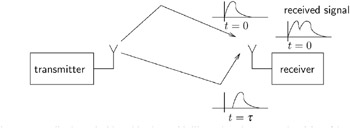
Generally, the performance of communication systems is limited by the interference, of which there are various sources. For example, multipaths of a radio channel cause intersymbol interference (ISI), as shown in Fig. 1.1. The received signal becomes a sum of delayed transmitted signals with different attenuation factors. Although the background noise is negligible, the ISI can degrade the performance because the received signal is distorted by the ISI.
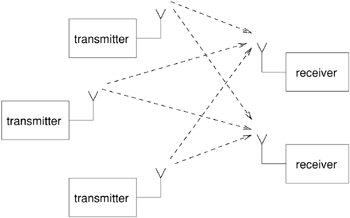
In a multiuser system, such as the one shown in Fig. 1.2, the other users signals become interfering signals. Thus, it is important to alleviate interfering signals to achieve a satisfactory performance.
Throughout this book, we introduce a few communication systems under interference-limited environments. For each communication system, adaptive and/or iterative signal processing methods are discussed to overcome...