Adaptive and Iterative Signal Processing in Communications
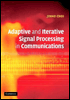
Using examples from practical transceiver designs, this book describes the fundamental theory and practical aspects of both methods, providing a link between the two where possible.
 TABLE OF CONTENTS
 Multiple antennas have been widely used in wireless communications to introduce diversity gain, because wireless communications suffer from fading. There have been various diversity techniques employed at both transmitters and receivers using multiple antennas (Lee, 1982).
The channel capacity of multiple antenna systems at both transmitter and receiver was investigated in Foschini and Gans (1998) and Telatar (1999), which revealed that the channel capacity can be significantly improved by using multiple antennas. Following this discovery, the fundamental issues underlying the practical implementation of multiple input multiple output (MIMO) channels have been studied extensively.
In this chapter, we study several detection techniques and iterative receivers for MIMO channels. An iterative receiver with channel estimation is also discussed. Again, the EM algorithm plays a key role in deriving the doubly iterative receiver that can detect and decode signals as well as estimate channel matrices. The reader is referred to Paulraj, Nabar, and Gore (2003) and Tse and Viswanath (2005) for detailed accounts of the channel capacity of MIMO channels and space-time processing techniques, subjects that are not addressed in this chapter.
In wireless communications, diversity techniques are important in combatting fading. To introduce diversity, various approaches can be taken. In this section, we focus on space diversity introduced by multiple antennas.
Suppose that there are N receive antennas for a flat fading channel. The received signal at the mth antenna is given by

where h m , l and