Adaptive and Iterative Signal Processing in Communications
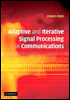
Using examples from practical transceiver designs, this book describes the fundamental theory and practical aspects of both methods, providing a link between the two where possible.
 TABLE OF CONTENTS
 In CDMA systems, the MAI degrades the performance. Various approaches may be teken to mitigate the MAI. For example, in linear multiuser detection, a linear transform or filtering is employed to mitigate the MAI. In this case, a dimension reduction occurs to suppress interfering signals in a vector space. Thus, if there are many interfering signals, linear multiuser detection becomes inefficient. Alternatively, the cancelation approach can be adopted. If it is possible to estimate interfering signals, they can be canceled without any dimension reduction. This approach becomes effective when the estimate of interfering signals is precise.
Generally, for coded CDMA systems, an optimal receiver has a prohibitively high computational complexity since joint detection and channel decoding is required. To avoid joint detection and channel decoding without siginificant performance degradation, an iterative receiver can be considered. In general, an iterative CDMA receiver consists of a multiuser detector and channel decoders. For multiuser detection, the MAP symbol detector can be an ideal choice. However, it would be impractical for a large number of users due to the high complexity (the complexity grows exponentially with the number of users). Therefore, a computationally efficient suboptimal multiuser detector is desirable. A cancelation-based approach would be preferable. Since decoded signals are more reliable, cancelation can effectively eliminate interfering signals whilst ensuring low complexity.
In this chapter, we study coded CDMA systems and iterative receivers with computationally efficient multiuser detectors. We also discuss multiuser detection with unknown interferers in the context of the iterative receiver.