Adaptive and Iterative Signal Processing in Communications
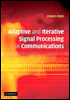
Using examples from practical transceiver designs, this book describes the fundamental theory and practical aspects of both methods, providing a link between the two where possible.
 TABLE OF CONTENTS
 We consider discrete-time signals and systems.
Linear systems. Consider an operator H[ ] which denotes a system. The output of the system H[ ] given input x l is denoted by H[ x l]. Then, a system is linear if

where a and b are constants and x l and y l are input signals.
Impulse response. The impulse response of a linear system is the output of the linear system when the input is a unit impluse:
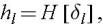
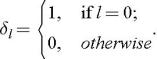
where ? l denotes the unit impulse defined as
Causal. A linear system is called causal if

Convolution. The convolution of x l and y l is defined as follows
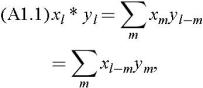
where * denotes the convolution (operation).
Output of linear systems. If a linear system has impulse response { h m}, given input x l, the output is given by
 -transform
 Definition. The -transform of signal x l is defined as follows:
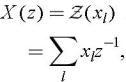
where z is a complex variable.
Convolution property. If y l = x l * h l, then

where Y ( z), X( z), and H( z) stand for the -transforms of y l, x l, and h l, respectively.
Shift property. If y l = x l ? m, then

Parseval s theorem. Let X