Advanced Model Order Reduction Techniques in VLSI Design

In this section, we present projection-based model order reduction techniques, which are widely used for parasitic interconnect circuit macromodeling and reductions. We mainly focus on model order reduction approaches based on Krylov subspace projection methods.
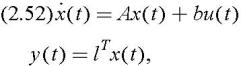
We consider a general linear time-invariant state-space model with only one input and one output (we will extend our discussion to multi-input, multi-output cases later),
where u is the input variable, y is the output variable, A is an n n matrix, and b is an n 1 matrix. x is an n 1 vector of state variables. Then the transfer function from u(t) to y(t) can be given as
Typically, the number of state variables, n, is very large so that the simulation and synthesis of the whole systems are very slow. We want to build a much smaller system, such that the transient response y(t) to some given input signal u(t) is approximate to that by the original system. One question we may ask is which parts of the system can be discarded without changing the transfer function H(s) significantly. The concepts of controllability and observability can give good answers: uncontrollable and unobservable parts of the system can be removed without affecting the transfer function [15].
To this end, we can perform the state transformation x= T z, where T is the matrix of...