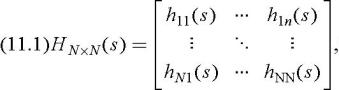
Circuit realization deals with the issue of interfacing the reduced models with a general circuit simulation like SPICE. After the model order reduction, we will typically end up with an admittance or impedance transfer matrix H(s)=B T (G + sC) ?1 B in the frequency domain, which can typically be rewritten as an N N matrix,
where N is the number of ports. Each of h ij can be a rational polynomial or in the partial fraction form with poles p i and corresponding residues k i .
There are two general ways to incorporate frequency-domain data like H N N (s) into a circuit simulator. The first method is to realize the frequency-domain data into a circuit with simple RLCM elements. The second method is by means of timedomain recursive convolution [14, 106]. Recursive convolution requires modification of the existing simulators and a new interface for getting the frequency domain data into the simulators. While realized circuits can easily be incorporated into the existing circuit simulators and are more portable among different simulators.
In this chapter, we focus on the circuit realization methods for the sake of circuit simulations. Our goal is different from the traditional circuit synthesis methods [127], where the synthesis is targeted at the physical realization of some network functions for implementing circuits, such as filters and matching networks. Instead, in our problem, we only need to build a models that can be used with circuit simulators. Such relaxed...
Copyright Cambridge University Press 2007 under license agreement with Books24x7


 TABLE OF CONTENTS