Antenna Engineering Handbook, Fourth Edition

Chapter 10: Surface-Wave Antennas

Francis J. Zucker
Rome Laboratory Hanscom Air Force Base

10.1 INTRODUCTION

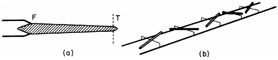
The two types of traveling-wave antennas discussed in this chapter are illustrated in Figure 10-1. In Figure 10-1 a, a surface wave (also called a trapped wave because it carries its energy within a small distance from the interface) is launched by the feed F and travels along the dielectric rod to the termination T. Since a surface wave radiates only at discontinuities, the total pattern of this antenna (normally end-fire) is formed by the interference between the feed and terminal patterns.1 The dielectric material could alternatively be an artificial one, e.g., a series of metal disks or rods (the Yagi-Uda antenna). On the other hand, discontinuities can be placed all along the surface-wave structure, producing radiation in the manner of a slotted waveguide except that the wave propagates on an open, not a shielded, guide. The array of dipoles proximity-coupled to a two-wire transmission line in Figure 10-1 b illustrates this second antenna type; here we are evidently using the term surface wave loosely to designate any wave mode that propagates along an open interface without radiating.


Figure 10-1: Surface-wave-antenna types ( a) dielectric rod and ( b) array of proximity-coupled dipoles (thin lines are dielectric supports)

Two closely related antenna structures are discussed in other chapters: the helix (which involves a surface wave in one of its modes of operation Chapter 12) and the frequency-independent antennas (Chapter 13). The short...

UNLIMITED FREE
ACCESS
TO THE WORLD'S BEST IDEAS

SUBMIT
Already a GlobalSpec user? Log in.

This is embarrasing...

An error occurred while processing the form. Please try again in a few minutes.

Customize Your GlobalSpec Experience

Category: Antennas
Finish!
Privacy Policy

This is embarrasing...

An error occurred while processing the form. Please try again in a few minutes.