Antenna Engineering Handbook, Fourth Edition

Arthur A. Oliner
Polytechnic University
David R. Jackson
University of Houston
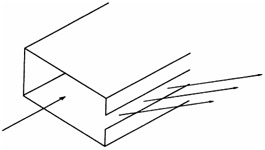
A leaky-wave antenna is basically a waveguiding structure that possesses a mechanism that permits it to leak power all along its length. The earliest example of such an antenna is a rectangular waveguide with a continuous slit cut along its side,1 ,2 as shown in Figure 11-1. Since leakage occurs over the length of the slit in the waveguiding structure, the whole length constitutes the antenna's effective aperture unless the leakage rate is so great that the power has effectively leaked away before reaching the end of the slit. Because of the leakage, the leaky waveguide has a complex propagation wave number, with a phase constant ? and a leakage constant ?; ? is large or small depending on whether the leakage per unit length is large or small. A large ? implies that the large leakage rate produces a short effective aperture, so that the radiated beam has a large beamwidth. Conversely, a low value of ? results in a long effective aperture and a narrow beam, provided the physical aperture is sufficiently long.
When the antenna aperture is finite and fixed beforehand and the leakage rate ? is small, the beamwidth is determined primarily by the fixed aperture, and the value of ? influences...