Applied Mathematical & Physical Formulas

Trigonometry is the branch of mathematics concerned with solving triangles, circles, oscillations, and waves using trigonometric ratios, which are seen as properties of triangles rather than of angles. It is absolutely crucial to much of geometry and physics. This section contains:
Fundamentals of Trigonometry
Trigonometric Equations
Graphs of the Trigonometric Functions
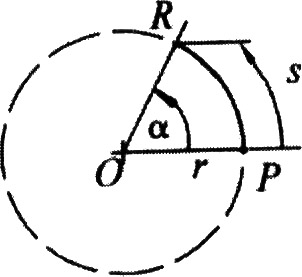
An angle is formed by two intersecting half lines or by rotating a half line from position OP to its terminal position OR. If the rotation is clockwise, the angle is deemed negative, and if counterclockwise the angle is deemed positive.

Circular measure
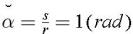
The circular measure is the ratio of the arc PR = s to the radius r.

Angular measure
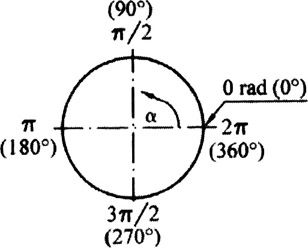
The angular degree symbolized by the ( ) is a unit of plane angular measure. There are 360 angular degrees in a complete circle. Each degree is divided into 60 minutes and each minute is divided into 60 seconds.
Relation between circular and angular measure:
| degrees | 0 | 30 | 60 | 90 | 180 | 270 | 360 |
|---|---|---|---|---|---|---|---|
| radians | 0 | | | | ? | | 2 ? |
| 0 | 0.50 | 1.05 | 1.57 | 3.14 | 4.71 | 6.28 | |
| 1 rad = 57.2958 degrees |
A circle centered in origin O and with radius=1 is called a trigonometric circle or unit circle.

The x-coordinate of point P is called the cosine of ?.
The y-coordinate of point P is called the sine of ?.
The y-coordinate of point Q is called the tangent...