Automotive Electronics Handbook, Second Edition
Use this guide to become an instant expert on today's leading edge auto electronic technologies--stability control, object detection, collision warning, adaptive cruise control, and more.
 TABLE OF CONTENTS
 Jerry L. Cage
Komatsu Mining Systems, Inc.
This chapter describes braking by first examining vehicle braking fundamentals, including the tire-to-road interface, vehicle dynamics, and conventional brake system components, and progressing to antilock systems objectives, components, safety considerations, control logic, and testing. The chapter concludes with a discussion of future vehicle braking systems.
For simplicity and because of applicability to the majority of automotive vehicles on the road, hydraulic brake systems as used on two-axle, nonarticulated vehicles will be discussed exclusively; this type of brake system is used on passenger cars, light trucks, and, in North America, on medium trucks.
Essential to the understanding of the technology associated with modern automotive vehicle braking is knowledge of the tire-to-road interface, vehicle dynamics during braking, and the components of a brake system. This section discusses these subjects to a system level of understanding.
The braking force generated at each wheel of a vehicle during a braking maneuver is a function of the normal force on the wheel and the coefficient of friction between the tire and the road. The simplified relationship between the weight on a wheel and the resulting frictional (braking) force is shown in Eq. (15.1).
| (15.1) | 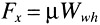 |
where
| Fx | = | friction force direction |
| ? | = | coefficient of friction, tire-to-road |
| W wh | = | static and dynamic weight on the wheel |
The tire-to-road coefficient of friction is not a constant but is a function of factors, most prominent being type of road surface...