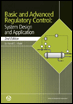
Basic and Advanced Regulatory Control: System Design and Application, 2nd Edition
PERFORMANCE CRITERIA

One decision that must be made very early in the loop-tuning procedure is a criterion for acceptable performance. Often this criterion specifies the decay ratio following a set point change. The traditional definition of decay ratio is the ratio of the deviation from set point at the second peak after a set point change to the deviation at the first peak. This is depicted in Figure 6.1a. Occasionally, the set point response is such that this definition is not useful. A better definition of decay ratio is the ratio of the difference between the second peak and its succeeding valley to the difference between the first peak and its succeeding valley. [1] This is depicted in Figure 6.1b. This definition, though more cumbersome, will work in all cases. Most of the time, however, the simpler and more widely used definition depicted by Figure 6.1a will suffice.

The decay ratio can also be defined for a disturbance or load upset. For a step change in load, the behavior depicted in Figure 6.1c is typical. Here, the decay ratio must be determined by the ratio of peak-to-valley differences. A load upset response like that depicted in Figure 6.1d is somewhat unusual for most processes, but is typical of the load upset response of level control loops.

One well-known criterion for controller tuning is a decay ratio of one-fourth following a set point change. This is also called "quarter-wave decay," "quarter-wave damping," and "quarter-amplitude decay." This criterion states that if...

UNLIMITED FREE
ACCESS
TO THE WORLD'S BEST IDEAS

SUBMIT
Already a GlobalSpec user? Log in.

This is embarrasing...

An error occurred while processing the form. Please try again in a few minutes.

Customize Your GlobalSpec Experience

Category: IC Electronic Filters
Finish!
Privacy Policy

This is embarrasing...

An error occurred while processing the form. Please try again in a few minutes.