Basic and Advanced Regulatory Control: System Design and Application, 2nd Edition
In my home, the thermostat the controller for the home heating system is always a focus of discussion. Either it doesn't match the wallpaper, which detracts from the decor of the room, or someone wants to place a lamp next to it, which causes the thermostat to give a false temperature reading, which in turn causes the room to be too cold.
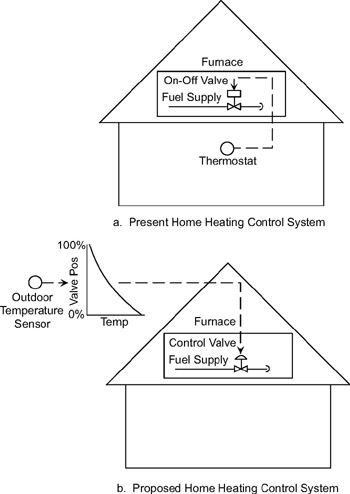
In the system shown in Figure 11-1a, the thermostat is an on/off device that controls a fuel supply solenoid valve. Suppose the following plan of action is being considered to get rid of the existing thermostat, thereby eliminating a point of discussion in the household:
The primary cause for variations in the heat delivered to the room is determined to be changes in the outdoor air temperature.
A suitable location is found for an outdoor air temperature sensor.
The present on/off valve is replaced with a throttling-type valve that can be positioned anywhere between 0 and 100 percent. (The technological details of this are beyond the scope of this book and are not essential to an understanding of the point being discussed.)
After considering the heat-transfer characteristics of the home's insulation, a program for required valve position versus outdoor air temperature is determined.
The system is implemented as shown in Figure 11-1b. The thermostat inside the house is eliminated. To control the fuel valve, the control system depends entirely on a measurement of the outdoor air temperature.
If this control...