The term advanced control is often used, abused, misused, and overused. Even among knowledgeable control engineers, the term does not have a consistent meaning. It is used to refer to everything from cascade control, which can be implemented with analog instrumentation, to optimization and model-based predictive control, which usually require a host computer interfaced to a lower-level distributed control or data acquisition system.
We use the term advanced regulatory control. By this we refer to a collection of control techniques, from ratio and cascade up through decoupling control and dead-time compensation. The unifying concept underlying the techniques that we include in advanced regulatory control is that they can all be implemented with hardware modules or, what is more likely, with software function blocks in a microprocessor-based control system. With technology such as FOUNDATION Fieldbus, it is also possible for these techniques to be implemented with function blocks distributed in fieldbus devices. We will not focus on the platform for implementation, however, other than to say that the techniques covered here are on a level below the control tasks that are traditionally reserved for a host computer, such as optimization, scheduling, and model predictive control.
The topics that we consider to be in the category of advanced regulatory control include:
-
Ratio control,
-
Cascade control,
-
Feedforward control,
-
Override control,
-
Control of multiple input, multiple output processes (decoupling control),
-
Dead-time compensation and elementary model-based control.
The last topic in this list will serve as a lead-in to model predictive...
Copyright ISA - The Instrumentation, Systems, and Automation Society 2004 under license agreement with Books24x7

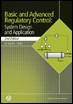
 TABLE OF CONTENTS