CNC Programming Handbook: A Comprehensive Guide to Practical CNC Programming, Second Edition

The main purpose of a CNC program development is to create a cutter tool path in a specific location of the part or machine. If the tool path requires both the right and left hand orientation, the programming time can be shortened by using a feature called the Mirror Image.
Any sequence of machining operations can be repeated symmetrically by using the mirror image feature of the control system. There is no need for new calculations, so this technique of programming reduces the programming time as well as the possibility of errors. Mirror image is sometimes called the Axis Inversion function. This description is accurate up to a point. Although it is true that in mirror image mode the machine axes will be inverted, but several other changes will also take place. This makes the Mirror Image description more accurate. Those who are familiar with a CAD system will find that the mirror image function in CNC is based on the same principles.
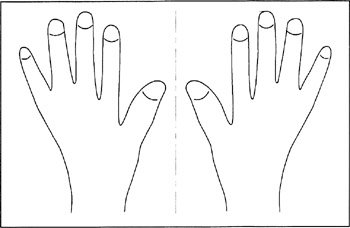
Mirror image is based on the principle of symmetrical parts, sometimes known as the Right Hand (R/H) and the Left Hand (L/H) parts (Figure 41-1).
Programming mirror image requires understanding of the basic rectangular coordinate system, particularly how it applies to quadrants. It also requires good grasp of circular interpolation and applications of cutter radius offset.
Earlier discussions established that there are four quadrants on a plane. The...