CNC Programming Handbook: A Comprehensive Guide to Practical CNC Programming, Second Edition

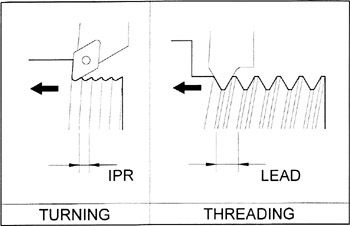
In threading, the choice of the cutting insert, the spindle speed and feedrate selection are rather restricted. Both, the cutting tool and the feedrate are determined by the finished thread, as specified in the engineering drawing. Threading insert is one of the weakest tools used on CNC lathes - yet its applications demand some of the heavist feedrates used in CNC lathe programming for any tool. Other factors that can influence the final thread have to be dealt with as well, such as spindle speed, the depth of each threading pass, the tool edge preparation, setup of the cutting tool and insert, plus similar considerations. Often, a change of only one factor will correct a threading problem. Figure 38-6 compares feedrates for turning and threading.
The selection of feedrate for general turning or boring is based on such factors as material type, tool nose radius, required surface finish, etc. In this sense, the correct feedrate for turning and boring cover a large range. In threading, this flexibility is limited. The threading feedrate is always determined by the lead of the thread - never the pitch. In English units drawings, the thread description is given as the number of threads over one inch length, or TPI (TPI = threads per inch), and a nominal diameter. As an example, a thread that is described in the drawing as 3.75-8, means that the...