Communications Network Test and Measurement Handbook
Bill Risley
Hewlett-Packard Co., Colorado Springs, Colorado
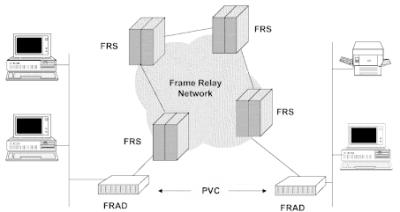
Frame relay is a highly efficient technology for routing data over wide area networks (WANs). Users from all segments of industry implement frame relay to improve performance, cut cost, simplify their networks, and improve reliability. Typical frame relay applications link remote local area networks (LANs) to central databases and other resources (Figure 8.1). Both ANSI and the ITU-T have established recommendations for frame relay, and the Frame Relay Forum has ratified a number of Implementation Agreements that have been widely accepted.
Frame relay is one of several Data Link layer (OSI layer 2) protocols, which are based on the High-Level Data Link Control (HDLC) bit-oriented protocol. These protocols are employed to organize user data in such a way that information of any type can be transferred error-free through the network.
To do this, the user data are encapsulated between header octets (which provide addressing and control information) and error-checking octets. This procession of octets the address, control field, user data, and error-check sequence is called a frame. Each frame is separated from other frames by the use of a special idle character. When no frames are being transmitted on the link, this...