Communications Network Test and Measurement Handbook
Mark Powell
Hewlett-Packard Co., Colorado Springs, Colorado
Integrated Services Digital Network (ISDN) provides a higher-bandwidth access for network subscribers and users of the Intelligent (or Integrated) Digital Network (IDN). Modern applications and information sources have pushed users of networking services to demand higher performance and higher access speeds. This includes people working from home, accessing cyberspace entertainment facilities from home, and working from offices and commercial locations. Older access technologies (analog modems, low-speed data services, packet-switched services) simply do not meet modern demands.
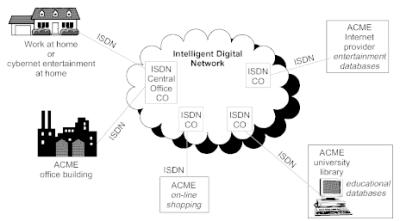
For a user working from home or at an office, ISDN provides the means of access to the IDN. Figure 9.1 shows the variety of locations from which users might need to access remote databases, connect to the local area network (LAN) at the office, or use any of the services available to users over the IDN. ISDN satisfies some important user demands placed upon these services: grade analog telephony service supporting one voice conversation over one pair of twisted wires extending from the user location to the telephone company or service provider Central Office (CO). For a private residence, there might be from one to three pairs of wires installed. Commercial premises that have a Private Branch Exchange (PBX) or LAN could have many pairs of twisted wires.
Greater bandwidth for higher-speed applications