Communications Network Test and Measurement Handbook
Stewart Day
Hewlett-Packard Australia Ltd., Victoria, Australia
Asynchronous Transfer Mode (ATM) is a network technology designed to meet the needs of the world s communications services, both today and into the future. It has been designed to allow integrating a wide range of services having diverse traffic characteristics and service quality requirements into a single network infrastructure. It is a highly scalable technology and can be used over physical interfaces with rates from as low as 1.5 Mbps to 2.4 Gbps and beyond.
ATM can be deployed in both local area network (LAN) and wide area network (WAN) environments, and therefore is suitable for both private enterprise and public carrier networks. With standards defining the internetworking of ATM with other technologies, such as Ethernet and frame relay, ATM can be deployed as part of a gradual migration to high-bandwidth integrated networks.
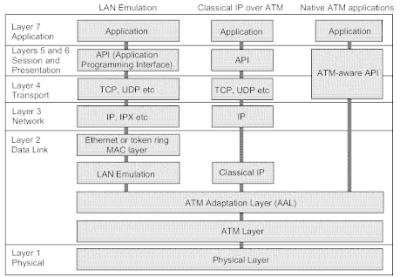
ATM is a connection-oriented technology using fixed-length packets. It effectively sits at layer 2 of the OSI protocol stack as a Data Link technology, although it also can be used to carry other layer 2 technologies (such as LANs), and additionally could be used as a layer 3 network technology (Figure 11.1). In its most popular current use, ATM is playing a significant part in the infrastructure growth of the Internet, where it is firmly placed as a layer 2 technology for IP.
Each ATM packet, or cell, is 53 bytes long, with a 5-byte header and...