Commercializing Successful Biomedical Technologies: Basic Principles for the Development of Drugs, Diagnostics and Devices

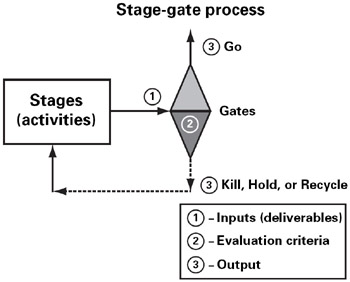
Stages are key areas of activity that define a functional area or focus. Moving from one stage to the next also generally correlates to major steps along the value chain (see Chapter 1). Gates are the decision-making evaluation points for the results of that stage. Each stage could have several evaluation criteria within a gate. If the outcome from that stage does not meet pre-defined parameters, then the project does not move on to the next stage of activity. For example, if a diagnostic test cannot demonstrate specificity to a certain pre-set level, then it cannot move on to clinical testing (Figure 4.6). An example gate for a drug would be the demonstration of efficacy in an animal model of the disease or the demonstration of adequate stability in formulation; without showing which the drug will not be allowed to move onto formal pre-clinical toxicity testing studies.
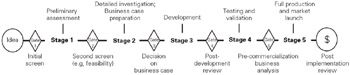
Cooper, in his original paper (1988), defined six stages of activity in a product development process and it is conceptually useful to see those original six stages and screening gates as shown in Figure 4.7.
Each stage should be focused on one key functional area with the gates defined by key risk-reducing results of that stage. Within each...