Condition Monitoring of Rotating Electrical Machines
Chapter 2: Construction, Operation and Failure Modes of Electrical Machines

2.1 Introduction

This chapter could also be subtitled 'the way rotating electrical machines fail in service'. Rotating electrical machines convert electrical to mechanical energy, or vice versa, and they achieve this by magnetically coupling electrical circuits across an airgap that permits rotational freedom of one of these circuits. Mechanical energy is transmitted into or out of the machine via a drive train that is mechanically connected to one of the electric circuits.

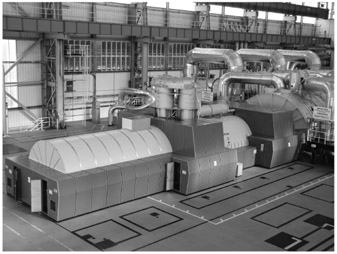
An example of one of the largest electromagnetic energy conversion units in the world, at 1 111 megavolt-amperes (MVA), is shown in Figure 2.1. The construction sof electrical machines is similar, whether large or small, as shown later in the chapter and their operational weaknesses are dominated by the same principles. The purpose of this chapter is to explain their constructional principles and the main causes of failure. The chapter is illustrated with a large number of photographs to demonstrate to the reader the salient features of electrical machines.


Figure 2.1: View of a 1 111 MVA, 24 kV, 50 Hz steam turbine-driven, hydrogen-cooled, two-pole turbine generator installed in a nuclear power station in the Czech Republic. The generator exciter is on the left, the turbine generator is in the centre of the picture and the low pressure turbine to the right. [Source Brush Turbogenerators]

UNLIMITED FREE
ACCESS
TO THE WORLD'S BEST IDEAS

SUBMIT
Already a GlobalSpec user? Log in.

This is embarrasing...

An error occurred while processing the form. Please try again in a few minutes.

Customize Your GlobalSpec Experience

Category: Turbine Repair and Maintenance Services
Finish!
Privacy Policy

This is embarrasing...

An error occurred while processing the form. Please try again in a few minutes.