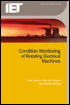
Condition Monitoring of Rotating Electrical Machines
Electrical insulation faults are a significant contributor to the failure of rotating machines. Industry studies described in the next chapter indicate that up to one-third of rotating machine failures can be attributed to loss of function of the stator winding electrical insulation. Therefore they deserve special consideration before we consider failure modes in general. However, it should be borne in mind that although the final failure mode may be electrical breakdown of a dielectric component, the underlying mechanism driving the breakdown may be thermal, mechanical or environmental stress as well as electrical factors. This section will cover the basic stresses that affect the performance of stator winding, stator core and rotor winding insulation systems on operating machines as well as discussing the roles that design, operation and maintenance have on the life of the equipment.
Insulation in service is exposed to high temperature, high voltage, vibration and other mechanical forces, as well as some adverse environmental conditions. These stresses can act together or individually to degrade insulation materials or systems. Thermal ageing of insulating material due to high temperatures has been studied the most and is perhaps best understood. The mechanism may be treated as a chemical rate phenomenon, described by the Arrhenius relationship, and includes loss of volatiles, oxidation, depolymerisation, shrinkage and embrittlement. In actual service, loss of insulation system integrity is aggravated by cyclic and transient mechanical forces, which cause relative movement and abrasion of insulation. Furthermore, insulation subjected to high voltage...