Designing Embedded Networking Applications: Essential Insights for Developers of Intel IXP4XX Network Processor Systems

This chapter describes using Intel IXP4XX Network Processors in multimedia applications. These applications can be grouped into two specific device classes:
Voice over IP (VoIP) adapters and gateways. This class of product uses the DSP capabilities of the IXP4XX network processors to provide VoIP CODEC support.
Display-based applications. This class of product shows the application of the IXP4XX network processor in point-of-sale applications, media-streaming platforms, industrial-controller user interfaces, and IP videophones.
Voice traffic has been carried over the IP networks of long-distance voice telephone providers for quite some time. With the massive acceptance of broadband services, VoIP-based services are now available to home and small office users. Broadband access (ADSL, cable modem) is used to provide the access infrastructure from your home to the provider's network. To help you understand the application context in which IXP4XX network processor-based products are deployed, we briefly describe the elements within a VoIP network.
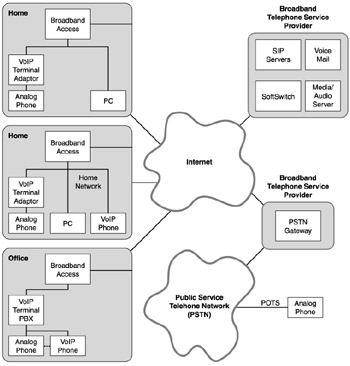
The VoIP-based network has several main components as shown in Figure 8.1.
These components are further explained in the following sections.
An adapter is needed to convert the analog voice signals into a digital form and then package these voice samples into IP packets. Several product classes exist that perform this function.
Analog Terminal Adapters. These adapters convert the signals from a regular analog phone into a stream of VoIP packets on an Ethernet interface. The adapter also registers with a...