Digital Television Systems

4.6: Concatenated Codes

4.6 Concatenated Codes

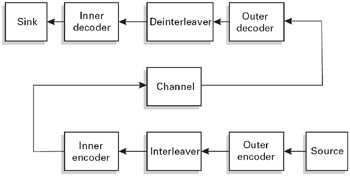
The technique called concatenation (Forney, 1966) was introduced by Forney and finds application in various digital television standards, as described in the remaining part of this chapter. Forney s concatenation technique is nowadays referred as serial concatenation. A serial concatenation coding scheme, as depicted in Figure 4.12, consists, on the transmitter side, of a cascade of an outer encoder for a block code capable of correcting byte errors, usually an RS code, with an interleaver (Ramsey, 1970, Forney, 1971) which is followed by an inner encoder for a convolutional code. The convolutional code is employed to combat uniformly distributed errors; however, a decoding failure may result in bursts of errors being delivered at the inner decoder output. On the receiver side, after being processed by the inner decoder, the bits pass through a deinterleaver, the function of which is to spread the bursts of errors on a byte basis in order to improve the burst error-correction capability of the outer decoder.


Figure 4.12: Serial concatenation coding scheme

More recently (Song et al., 2007), serial concatenation employing two block codes has been described, but with a different perspective. The inner code is an LDPC code, capable of correcting most of the errors but suffering from an error-floor (Lin and Palais, 1986) limitation, and the outer code is a BCH code, capable of correcting practically all the errors that escaped correction by the LDPC code.

The coding scheme known as turbo coding (Berrou et al

UNLIMITED FREE
ACCESS
TO THE WORLD'S BEST IDEAS

SUBMIT
Already a GlobalSpec user? Log in.

This is embarrasing...

An error occurred while processing the form. Please try again in a few minutes.

Customize Your GlobalSpec Experience

Category: Error Correction Chips
Finish!
Privacy Policy

This is embarrasing...

An error occurred while processing the form. Please try again in a few minutes.