A random signal, or a stochastic process, is an extension of the concept of a random variable, involving a sample space, a set of signals, and the associated probability density functions. Figure C.1 illustrates a random signal and its associated probability density function.
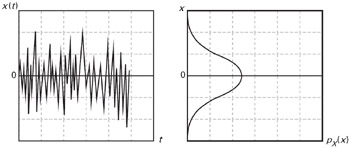 Figure C.1: Example of a random process and its corresponding probability density function
 A stochastic process X ( t) defines a random variable for each point on the time axis, and it is said to be stationary if the probability densities associated with the process are time-independent.
C.1 The Autocorrelation Function
The autocorrelation function is an important joint moment of the random process X ( t), and is defined as
in which E[ ] represents the expected value of the process.
The random process is called wide-sense stationary if its autocorrelation depends only on the interval of time separating X ( t) and X ( ?), i.e. it depends only on ? = ? ? t. Equation (C.1) in this case can be written as
In general, the statistical mean of a time signal is a function of time. Thus, the mean value
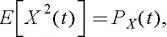
the power
and the autocorrelation
are, in general, time-dependent.
However, there exists a set of signals the mean values of which are time-independent. These signals are called stationary signals. A signal is stationary whenever its probability density function is time-independent, i.e. whenever p X ( x, t) = p X ( x).
C.1.1
Copyright Cambridge University Press 2009 under license agreement with Books24x7


 TABLE OF CONTENTS