Digital Television Systems

Appendix B: Signal Analysis

B.1 Introduction

The objective of this appendix is to provide the reader with the necessary mathematical basis for understanding the characteristics of signals which are related to their analysis and transmission through communication channels. Concepts and equations involving the Fourier transform, which constitute powerful tools for spectral analysis, are presented (Alencar, 1999).

B.2 Fourier Transform

The direct Fourier transform is a mapping from the time to the frequency domain,


it is sometimes denoted in the literature as F ( ?) = [ f ( t)].

The inverse Fourier transform can be defined in a similar manner, as


A Fourier transform pair is often denoted as f ( t) ? F ( ?).

Fourier transforms of known signals are presented in the following (Haykin, 1988).

Pulse function

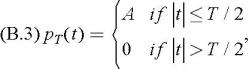
The pulse function is used to aid in the simulation of digital signals, and is defined by the expression p T ( t) = A[ u( t + T/2) ? u( t ? T /2)], or


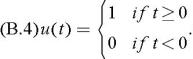
in which u( t) denotes the unit step function, defined as


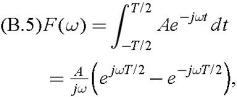
The pulse function is illustrated in Figure B.1. The Fourier transform of the pulse function can be calculated as


which can be put in the form


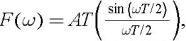
and finally


in which Sa ( x) = sin( x)/ x is the sampling function. This function converges to 1, as x goes to zero. The sampling...

UNLIMITED FREE
ACCESS
TO THE WORLD'S BEST IDEAS

SUBMIT
Already a GlobalSpec user? Log in.

This is embarrasing...

An error occurred while processing the form. Please try again in a few minutes.

Customize Your GlobalSpec Experience

Category: Data Acquisition
Finish!
Privacy Policy

This is embarrasing...

An error occurred while processing the form. Please try again in a few minutes.