Digital Terrain Modeling: Acquisition, Manipulation, and Applications

Commercialization of the direct georeferencing systems for all application areas has been done by Applanix Corporation (now a subsidiary of Trimble, http://www.applanix.com) and iMAR GmbH (http://www.imar-navigation.de). The tables of results shown in the following are not based on a comprehensive analysis of published results. They are rather samples of results achieved with specific imaging systems and have been taken from company brochures and technical publications. The authors think that they are representative for the systems that have been discussed previously.
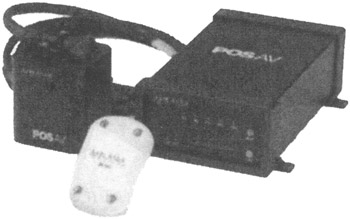
The accuracy specifications for the Applanix family of POS/AV (see Figure 2.8) airborne direct georeferencing systems are listed in Table 2.2 (Mostafa et al., 2000). The primary difference in system performance between the POS/AV 310 and POS/AV 510 systems is the orientation accuracy, which is directly a function of the IMU gyro drifts and noise characteristics. For example, the gyro drifts for the POS/AV 310 and POS/AV 510 systems are 0.5 deg/hr and 0.1 deg/hr, respectively, while the corresponding gyro noises are 0.15 and 0.02 deg/hr -1/2, respectively.
| Parameter Accuracy (RMS) | Model 310 | Model 410 | Model 510 |
|---|---|---|---|
| Position (m) [DGPS] | 0.1 0.3 | 0.05 0.3 m | 0.01 0.03 |
| Velocity (m/s) | 0.01 | 0.005 | 0.005 |
| Roll / pitch (deg) | 0.013 | 0.008 | 0.005 |
| True heading (deg) | 0.035 | 0.015 | 0.008 |
| Gyro drift (deg/hr) | 0.5 | 0.5 | 0.1 |
| Noise (deg/sqrt(hr)) | 0.15 | 0.07 | 0.02 |
| Source: Mostafa et al. (2000). |
The accuracy...