Digital Terrain Modeling: Acquisition, Manipulation, and Applications

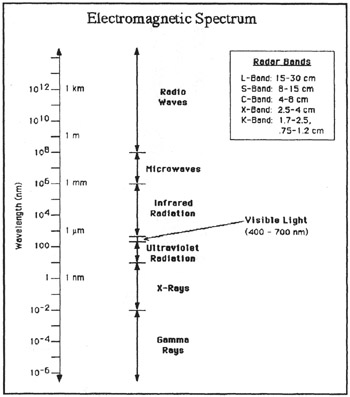
RADAR (radio detection and ranging) are active remote sensing systems (as they provide their own source of illumination). Radio waves are that part of the electromagnetic spectrum that has wavelengths considerably longer than visible light. See Figure 2.23 for more details of the electromagnetic spectrum. Radar sensing has been developed on the basis of four technological principles. These are(Olmsted, 1993):
The ability of an antenna to emit a brief electromagnetic pulse in a precise direction;
The ability to detect, also with directional precision, the greatly attenuated echo scattered from a target;
The ability to measure the time delay between emission and detection and thus the range to the target;
The ability to scan with the directional beam and so examine an extended area for targets.
A radar system, therefore, typically consists of a transmitter, an antenna, and a receiver. The transmitter generates a microwave pulse of short duration (effective pulse length determines range resolution). The transmitted pulse is focused into a narrow beam by an antenna to illuminate the imaged swath. The antenna receives that portion of transmitted energy signal retroreflected by the terrain/target. The receiver measures the delay and strength of the returned signal, and relates transmission/reception time delay to the range to the object from the radar. The ranging is accomplished by measuring time delay between transmission and reception of signals by knowing radio waves travel at the speed of light (c = 3 10 8 m/sec).