Dry Gas Seals Handbook

Dry gas seals are gas-lubricated, mechanical, noncontacting, end-face seals, consisting of a mating (rotating) ring and a primary (stationary) ring. The principal rotating components consist of (fig. 2-1)
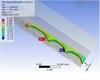
a mating ring that contains grooves machined near the outer diameter of the face of the ring (fig. 2-2). The grooves are machined only to the radial midpoint of the ring face, and the groove depth is only a few microns. The shape of the grooves in the mating ring (the groove pattern) is optimized to enhance seal performance (explained later in this chapter).
Figure 2-2: Grooves in seal mating ring
a shaft sleeve that encloses (shrouds) the mating ring. The shaft sleeve is affixed to the compressor rotor, causing the sleeve and mating ring to rotate at shaft rotational speed.
a locking sleeve that secures the mating ring in the axial direction.
various o-rings that seal the mating surfaces and provide secondary sealing. Some or all of these o-rings are replaced with polymer seals such as PTFE (polytetrafluoroethylene) in high-pressure applications.
a shear ring that typically fits into a groove in the compressor rotor and secures the gas seal assembly in the axial position. The shear ring absorbs the thrust load exerted on the seal assembly.
The principal stationary components consist of (fig. 2-1)
a primary ring that seals against the mating ring and is capable of axial movement to "float" with the mating ring.
A set of springs that applies a...