Dry Gas Seals Handbook

As discussed in chapter 3, a barrier seal is an integral component of the dry gas seal assembly, installed outboard of the dry gas seal (see chapter 3 figures). The barrier seal, sometimes referred to as a separation seal, separates the gas seal from the compressor shaft bearings. A separation gas (typically nitrogen or air) is injected into the barrier seal, whose primary function is to prohibit the flow of bearing lubrication oil or oil mist into the gas seal. The barrier seal also serves as the last defense in the event of a catastrophic failure of the primary and secondary gas seals.
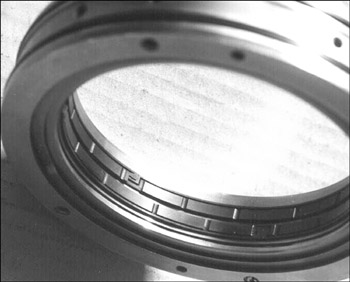
In the early years of gas seal applications, labyrinth seals were the only available option for the prevention of lube oil migration into the gas seal, and they proved to be quite effective. The current state-of-the-art barrier seal is the segmented carbon ring seal (fig. 4-1), which has replaced labyrinth seals in most barrier seal applications. Segmented carbon ring barrier seals offer the advantage of substantially lower separation gas consumption because of their much smaller shaft clearance compared to labyrinth seals.
Segmented carbon ring barrier seals are typically comprised of two sets of circumferential rings, an inboard ring and an outboard ring, contained within a housing (fig. 4-2). Each ring consists of several carbon segments that are held together by a garter spring around the circumference of the ring. The inboard and outboard rings are held in place axially...