EIT Civil Review, Second Edition

Dr. Braja M. Das
The particle size distribution in a given soil is determined in the laboratory by sieve analysis and hydrometer analysis. For classification purposes in coarse-grained soils, the following two parameters can be obtained from a particle size distribution curve:
| (1) | ![]() |
| (2) | ![]() |
where D 10 , D 30 , D 60 = diameters through which, respectively, 10%, 30%, and 60% soil pass.
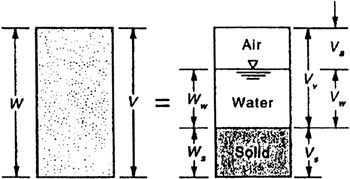
Soils are three-phase systems containing soil solids, water, and air (Fig. 1). Referring to Fig. 1
| (3) | |
| (4) | |
where W = total weight of the soil specimen, W s = weight of the solids, W w = weight of water, V = total volume of the soil, V s = volume of soil solids, V v = volume of voids, V w = volume of water, and V a = volume of air.
The volume relationships can then be given as follows:
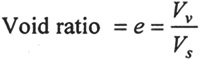
| (5) | ![]() |
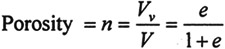
| (6) | |
| (7) | |
Similarly, the weight relationships are:
| (8) | |
| (9) | ![]() |
| (10) | |
| (11) | ![]() |
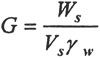
In the preceding equations, ? w = unit weight of water (62.4 lb/ft 3 or 9.81 kN/m 3), and G = specific gravity of soil solids, or
| (12) | ![]() |
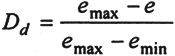
In granular soils, the degree of compaction is generally expressed by a nondimensional parameter called relative density, D d, or
| (13) | ![]() |
where e = actual void ratio in the field, e max = void ratio...