EIT Civil Review, Second Edition

Dr. Bruce E. Larock
This chapter will review the two equations that are likely to be found in the FE examination. A more thorough presentation may be found in the Civil Engineering License Review or in selected references at the end of this chapter.
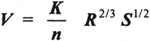
The Manning equation for the average velocity V in a steady open channel flow is
With SI units K = 1.0; with English units K = 1.49. The hydraulic radius is R= A/P with A = flow cross-sectional area and P = wetted perimeter, i.e. the length of the interface along the fluid/solid boundary containing it. The slope S of the energy line is equal to the amount of head lost in a channel section of length L, or S = h L/L. A short table of values for n, the Manning roughness factor, follows:
| Channel Surface | Roughness Value n |
|---|---|
| Concrete, finished | 0.012 |
| Concrete, gunite | 0.019 |
| Clay, vitrified sewer | 0.014 |
| Rubble masonry | 0.025 |
| Concrete, mortar | 0.013 |
| Concrete, troweled | 0.013 |
| Gravel, clean | 0.025 |
Although the Manning equation is intended primarily for use in open channels, it is sometimes also used for pressurized flow in pipes.
Q:
A rectangular open channel lined with rubble masonry is 5 meter wide and laid on a slope of 0.0004. If the depth of uniform flow is 3 meter, compute the discharge in m 3/sec.
Answers
Q:
From the table the Manning roughness is approximately n = 0.025. The area and wetted perimeter are
A =...