EIT Civil Review, Second Edition

| 1. | A soil specimen has a void ratio of 0.6, moisture content of 10%, and G = 2.67. Determine the moist unit weight.
|
|
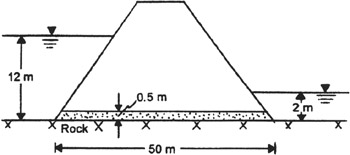
| 2. | Calculate the seepage loss through the 0.5 m thick sandy silt layer below the earth dam shown (m 3/hr/m). Given: coefficient of permeability, k = 3.66 cm/hr.
![]() |
|
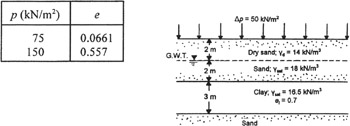
| 3. | A normally consolidated clay layer having a thickness of 3 m is shown. A laboratory consolidation test on the same clay gave the following results: ![]() The settlement of the clay layer due to a surcharge ? p = 50 kN/m 2 is closest to:
|
|
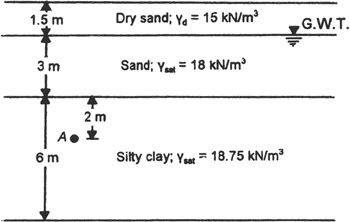
| 4. | A silty clay layer of 6 m thickness is shown. It has a drained friction angle of 21 and a cohesion of 20 kN/m 2. What would be the drained shear strength at A (in kN/m 2)?
![]() |
|
| 5. | For a granular soil, the dry unit weight in the field is 16.35 kN/m 3. The maximum and minimum dry unit weights of the same soil as determined in the laboratory are 17.6 kN/m 3 and 14.46 kN/m 3, respectively. Given G = 2,66, the relative density of compaction in the field is closest to:
|
|
| 6. | For a clayey soil, given: Plasticity index = 18 Plastic... |