EIT Civil Review, Second Edition

Kenneth J. Williamson
Wastewater flows are comprised of domestic and industrial wastewaters, infiltration, inflow, and storm water. Most modern sanitary sewers are separated from storm water systems so these flows are treated separately. Modern sewers are constructed so that inflow rates are assumed to be negligible.
Domestic flows are determined from water use rates with typical values being 0.57 m 3 per day per capita. Industrial and infiltration flows vary widely. Specific data are required based upon industry and production rates.
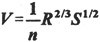
Sewers are designed as open channels, usually with a circular cross section. Flows in sewers are modeled using Manning's Eq. as:
| (5-1) | |
where:
| V | = | velocity (m/s); |
| n | = | Manning coefficient, 0.013; |
| R | = | hydraulic radius (m); and |
| S | = | slope of hydraulic grade line. |
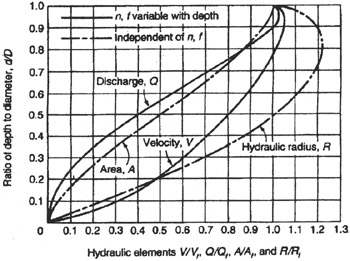
The relation between the hydraulic radius and the flow depth for a circular cross section is a complex relationship; as a result, flows in partially full sewers are calculated using nomographs as in Figure 5-1.
Design calculations usually involve knowing the slope of the sewer (S), and the partially-full flow rate, Q. The nomograph is solved by assuming a pipe diameter (D), solving for the full flow rate, Q f. From the ratio of Q/Q f, the ratio of partial depth to pipe diameter (d/D) is obtained from the nomograph, from which the depth of flow is calculated. Sanitary sewers are designed to carry the peak flow with a depth of flow...