EIT Industrial Review, Second Edition
This toolbook provides a complete review for the Industrial section of the Engineer in Training State licensing exam. It reviews each topic with numerous example problems and complete step-by-step solutions.
 TABLE OF CONTENTS
 In the 60-question afternoon session of the FE Exam for industrial engineers, expect three questions on queueing and stochastic modeling and three questions on simulation.
Let p ij be the conditional probability of state j the next epoch after state i. A transition matrix of these conditional probabilities is a stochastic matrix (row sums are 1):
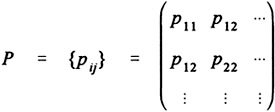
(The states may be numbered from 0 rather than 1.) Left-multiplying a row vector of state probabilities onto P solves the total probability formula. For example, if a two-state system starts out having a 40% probability of being in the first state and P is as below, then it has a 74% probability of being in that state the next epoch:

If long-run probabilies { p i} of being in each state exist, their vector should yield the same vector { p i}, and they can be found by solving the matrix-multiplication equation (for one of them, substitute 1 minus the sum of the others):
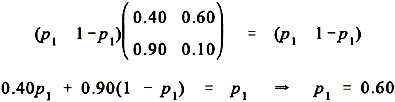
(In the long run, our system is in the first state 60% of the time.)
Problem and Solution to Example
| 1. | Three machines each have a Markovian failure rate ? = 0.20 failures per hour, and the operators can fix them at Markovian rates ? 1 = 0.50, ? 2 = 0.80, and ? 3 = 1.00 fixes per hour, respectively, when 1, 2, or 3 machines are down. For an infinitesimal... |