EIT Industrial Review, Second Edition
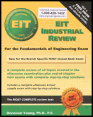
This toolbook provides a complete review for the Industrial section of the Engineer in Training State licensing exam. It reviews each topic with numerous example problems and complete step-by-step solutions.
 TABLE OF CONTENTS
 In the 60-question afternoon session of the FE Exam, expect three questions on work performance and methods and three questions on industrial ergonomics.
Industrial engineers are expected to know the basic definitions and concepts of work measurement without needing to consult reference materials.
A task is a sequence of elements. Each task or element must have a definite end event that is also the start event for the next task or element. All time that is not part of a task or element is allowance time time allowed for personal activity (breaks, phone calls), fatigue, and delays.
Time study yields observed times; let the ith replication of the observed time (observed duration) of task or element j be denoted O ij. The observed time is measured by videotape or stopwatch as the time from the start event to the end event (after subtraction of the duration of any allowance-time interruptions).
Each observed time O ij is converted to a normal-time datum N ij by multiplying by the pace rating, R ij, which is a subjective estimate of the pace of the work. Normal pace ( R ij = 1.00) is defined as the speed at which a typical experienced worker would be expected to work; R ij = 0.85 would express that the worker was working at a pace such that the number of completions per unit time would be 85% of those at...