Electromagnetic Band Gap Structures in Antenna Engineering

The periodic boundary condition based on the constant k x method is applicable for both the guided wave analysis and scattering calculation, as demonstrated in the previous two sections. Thus, it provides an opportunity to combine the guided wave and scattering analysis in a single FDTD simulation. This section introduces the unified FDTD approach [39], including the concept, the oscillation problem, and the auto-regressive moving average (ARMA) estimator [40] in time domain data processing. The accuracy of the unified approach is demonstrated by several examples.
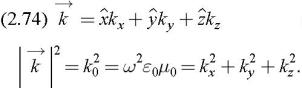
To understand the unified approach, let s revisit the definitions of the surface wave region and the plane wave region. For an electromagnetic wave at a given frequency f, the free space wavenumber is calculated as below:
The propagation vector
can be decomposed in the rectangular coordinate:
For a given combination of horizontal wavenumbers ( k x, k y), if the frequency ? is small and the following equation is satisfied,
then the value of k z must be a purely imaginary number in order to satisfy (2.74). As a result, the field decays exponentially in the z direction. The electromagnetic wave is a surface wave propagating horizontally. If the frequency ? is large and the following equation is satisfied,
then the value of k z is a real number.