Electromagnetic Band Gap Structures in Antenna Engineering

Over the last decade, diversified and novel electromagnetic band gap (EBG) structures have appeared in the literature. They exhibit interesting electromagnetic properties, which are not readily available in natural materials. In this chapter, we illustrate these interesting properties of EBG structures. A classification of various EBG structures is also provided.
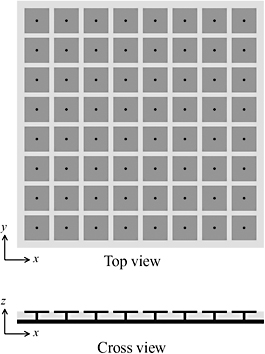
To more readily understand the operation mechanism of EBG structures, some circuit models have been proposed. Let s start with a simple two-dimensional planar electromagnetic band gap (EBG) structure, as shown in Fig. 3.1. This structure was originally proposed in [1]. The EBG structure consists of four parts: a metal ground plane, a dielectric substrate, periodic metal patches on top of the substrate, and vertical vias connecting the patches to the ground plane. The geometry is similar to the shape of a mushroom.
The parameters of the EBG structure are labeled in Fig. 3.2a as patch width W, gap width g, substrate thickness h, dielectric constant ? r, and vias radius r. When the periodicity ( W + g) is small compared to the operating wavelength, the operation mechanism of this EBG structure can be explained using an effective medium model with equivalent lumped LC elements, as shown in Fig. 3.2b [2]. The capacitor results from the gap between the patches and the inductor results from the current along...