Electronic Materials and Processes Handbook, Third Edition
Charles Cohn
Agere Systems
Allentown, Pennsylvania
At the end of the nineteenth century, the consumer products of that time included simple electrical circuits for lighting, heating, telephones, and telegraph. But the invention of radios and the need for electrical components that could rectify and amplify signals spurred the development of vacuum tubes. Vacuum tubes were found in products such as radios, televisions, communication equipment, and in early computers. Their use lasted until the late 1960s, when the development of semiconductor devices ushered in a new era in electronics. The semiconductor, containing an array of complex transistors and other components on a single IC chip, provided improved reliability and reduced power, size, and weight, and it made possible today s sophisticated electronic products.
This chapter, which is subdivided into five sections, presents a simplified approach to the understanding of the fundamentals of semiconductors, IC development, and IC chip fabrication. The topics cover
Atomic structure
Vacuum tubes
Semiconductor theory
Fundamentals of integrated circuits
IC chip fabrication
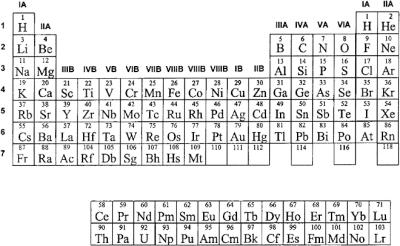
All matter, whether solid, liquid, or gas, is composed of one or more of the 109 presently recognized elements referenced in the periodic table (Fig. 1.1). Of these, 91 elements occur naturally, and the rest are either man-made or are by-products of other elements. An element is composed of molecules, which are divisible into even smaller particles called atoms. The atomic structure for each element is unique and defines the element s properties.